Different minds.
Shared possibility.
Adapt learning to diverse minds. Preserve curiosity, individual agency and the freedom to question.
 EVREKA™
An exploration of education in the AI era: human-centered intelligence, ethical AI literacy, and trust grounded in evidence and human agency.
Explore the curriculumExplore the EVREKA vision for education as human and machine intelligence develop alongside one another.
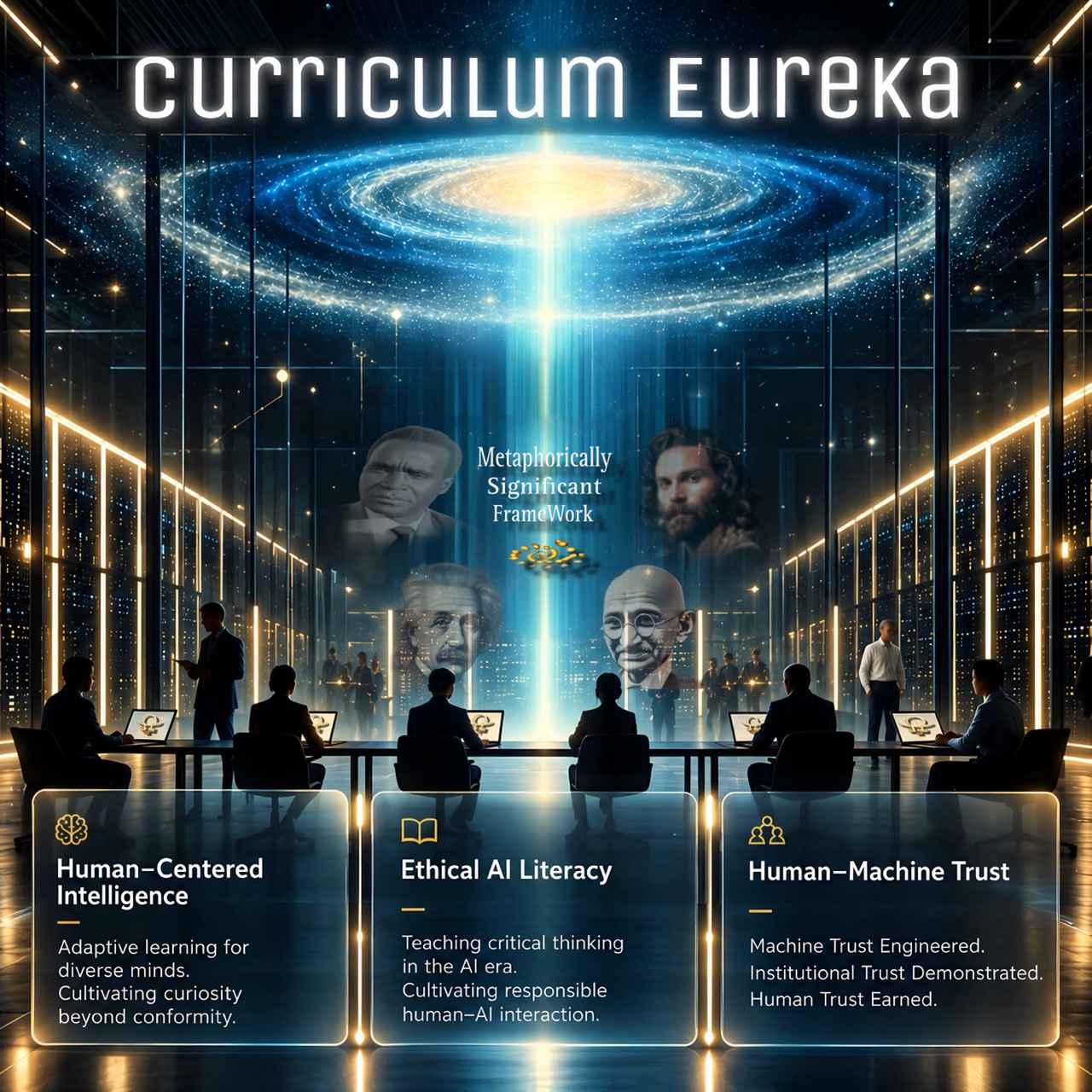
Adapt learning to diverse minds. Preserve curiosity, individual agency and the freedom to question.
Examine evidence, recognise limitations and practise responsible interaction with AI.
Machine trust is engineered. Institutional trust is demonstrated. Human trust is earned.
The starting point is humans and machines learning alongside one another while preserving curiosity, responsibility and humanity. Inquiry connects historical perspectives with the practical questions raised by AI.
Notice, question and make space for different perspectives. Identify what learners want to understand.
Gather evidence, test ideas and use subject knowledge to look beneath the surface.
Develop a response through writing, design, experimentation or collaborative creation.
Explain the thinking, consider feedback and decide which question to explore next.
Build resilient, easy-to-understand architectures that people can explore, understand and build upon — for the generations to come.
 EthicTech | Industry Sector
Curriculum EVREKA uses historical lives as lenses for questions about intelligence, responsibility and learning. These are invitations to inquiry, including examination of each figure's complexities.
Zambia's first president offers a lens on nationhood, community and the challenge of building unity across linguistic and cultural differences.
How can a shared purpose make room for different identities?
His exploration of time and space invites learners to connect established knowledge with imaginative questions. His life also makes room for a critical discussion of relationships and responsibility.
When does imagination help us move beyond what we already know?
Non-violence, dignity and self-discipline provide a lens on how change is pursued. Examine the relationship between an intended outcome and the conduct used to reach it.
How do the methods we choose shape the world we create?
Art, anatomy, geometry, engineering and observation meet in Leonardo's work. His investigations of flight invite learners to transfer ideas across disciplines and keep learning throughout life.
What becomes possible when knowledge from one field meets another?
Trust in AI is not a single judgment. Investigate technical reliability, institutional accountability and human judgment separately. Confidence in one layer does not establish trust in the others.
Can the system perform reliably within a defined task?
Compare an AI-generated explanation against teacher-selected sources. Change the wording of the question and identify errors, unsupported claims and inconsistent answers.
Evidence to collect: verified claims, failure cases and the limits of the task.
Does the organisation show accountable practice?
Review a fictional school AI policy. Ask who is responsible, how decisions can be challenged, what data is used and what happens when harm is reported.
Evidence to collect: clear responsibilities, explanations and a workable route for redress.
Do people exercise care, honesty and judgment?
Discuss a scenario in which an AI recommendation conflicts with a learner's needs. Explain when a person should question it, seek help or decline to use it.
Evidence to collect: reasoning, openness about uncertainty and respect for agency.
Suggested classroom adaptations of the discussion shared by Simon Falk. Use fictional scenarios and teacher-selected material; no personal learner data is needed.
This curriculum direction brings together the supplied Curriculum EVREKA discussion and its linked reading on education, intelligence and trust.
Beyond AI in the classroomHuman-centered intelligence and trust. Read the original article on LinkedIn.
Curriculum EVREKA | LinkedIn discussion Four Beautiful Minds. Three pillars.Explore the framework and the conversation about learning through experience.
Framework discussion: Simon Falk. Curriculum EVREKA | Metaphorically Significant™ FrameWork. Page summaries are adapted from the supplied post screenshots; full linked article text has not been reproduced.
Explore example inquiries that connect disciplines and give learning a shared purpose. Adapt the depth, materials and outcomes to your learners.
Look closely at a local habitat to understand the relationships between living things and their environment.
Observe a nearby green space. Record what lives there, compare conditions and map the connections you find.
Build an evidence-based habitat guide or propose a small change that could support local biodiversity.
What did your observations reveal? What would you need to investigate before making a recommendation?
Investigate everyday objects and discover how observation, constraints and experimentation shape an invention.
Choose an everyday problem. Study existing solutions, interview people who experience it and identify the constraints.
Make and test a prototype. Measure what works, document your choices and improve the design with feedback.
Whose needs did your design address? Which evidence helped you decide what to change?
Explore how stories, spaces and shared experiences shape the identity of a community.
Compare maps, collect local stories and examine how a familiar place has changed over time.
Curate a community story map using researched accounts, original writing and carefully chosen places.
Which perspectives are represented? What stories are missing, and how could you learn more?
Curriculum EVREKA is an emerging educational architecture developed within the Metaphorically Significant™ FrameWork, exploring how human curiosity, artificial intelligence, critical reflection, and interdisciplinary understanding can reshape the future of learning.
At its philosophical foundation lies a deceptively simple question: How do we know that what we know is true?
Inspired by the ancient Greek expression εὕρηκα — “I have found it!” — Curriculum EVREKA places the moment of discovery at the heart of education.
The initiative explores a transition from knowledge transmission and memorisation towards learning environments that cultivate curiosity, independent reasoning, contextual understanding, and the ability to question established assumptions.
Rather than positioning artificial intelligence as an automated answer machine, Curriculum EVREKA envisions AI as a companion in discovery — supporting learners in developing their own understanding while preserving human agency and intellectual independence.
 Inter Dimensional Computation | IDC™
IDC™ explores computation across connected dimensions: ethical reasoning considers values, responsibility and consequences; temporal understanding considers sequence, memory and change; contextual intelligence considers the circumstances in which a decision is made. Within Curriculum EVREKA, these ideas offer a conceptual lens for reflecting on how knowledge is formed and how intelligent systems support human judgement.
Explore IDC on YourFinestOut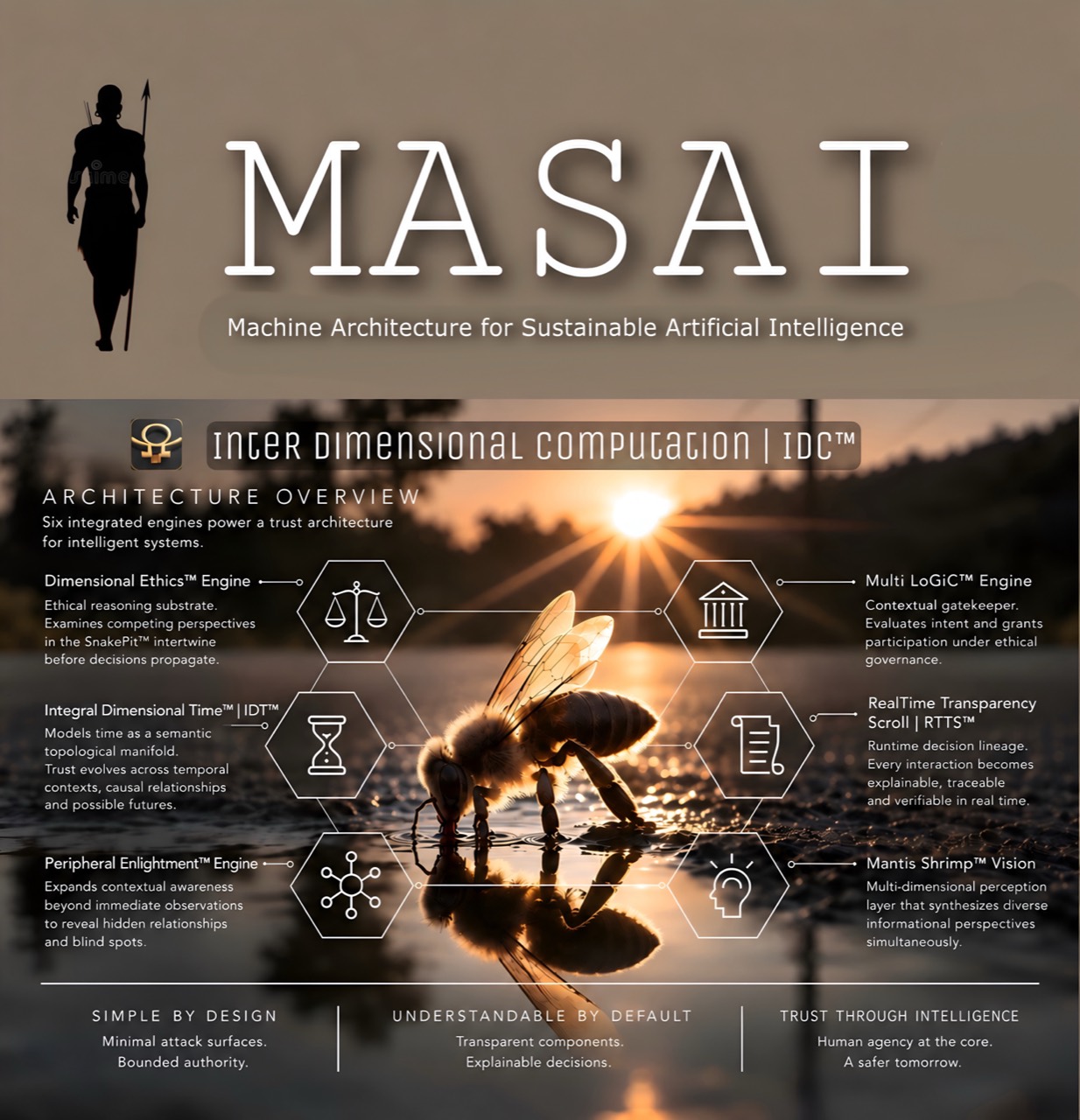
Through its conceptual relationship with Inter Dimensional Computation | IDC™, the architecture also investigates how ethical reasoning, contextual intelligence, memory, and temporal understanding could contribute to more adaptive, transparent, and human-centred educational experiences.
Originating within YourFinestOut and created under the auspices of Aurora Ethica, a nonprofit initiative, Curriculum EVREKA is being developed as a conceptual foundation for future educational research, interdisciplinary collaboration, and potential AI-enhanced learning applications.
Our ambition is not merely to teach what humanity already knows, but to nurture the curiosity, wisdom, and imagination required to discover what humanity does not yet understand.
From information to understanding.
From understanding to discovery.
A nonprofit initiative supporting the creation of Curriculum EVREKA.
auroraethica.aiauroraethica.org
Common’s hub at auroraethica.org | Space in development
Learning to Understand How We Know
Education should not merely prepare us for the world as it is. It should empower us to imagine, question and shape what it could become.
Curriculum EVREKA is an emerging interdisciplinary educational initiative within the Metaphorically Significant™ FrameWork, created under the auspices of Aurora Ethica, a nonprofit initiative and originating within YourFinestOut. It explores a more interconnected, ethical and intellectually curious approach to learning.
Our vision extends beyond traditional curricula and the Theory of Knowledge. We seek to connect philosophy, science, mathematics, history, the arts, technology and human experience through a shared architecture of understanding.
Understanding not only what we know, but how we came to know it.
Cultivating curiosity, experimentation and the courage to challenge assumptions.
Developing ethical judgement, empathy and awareness of consequences.
Recognising relationships across disciplines, cultures, generations and systems.
Exploring how artificial intelligence can enhance education while preserving human agency, creativity and independent thought.
Recognising education as an evolving process rather than a destination defined by examinations or degrees.
We envision learning environments where questions are as valuable as answers, understanding matters more than memorisation, and every learner can contribute to our collective intelligence.
From knowledge to understanding.
From understanding to wisdom.
From wisdom to meaningful action.
Curriculum EVREKA is still taking shape, and we invite educators, researchers, students, philosophers, technologists and curious minds worldwide to participate in its development.
Join the conversation